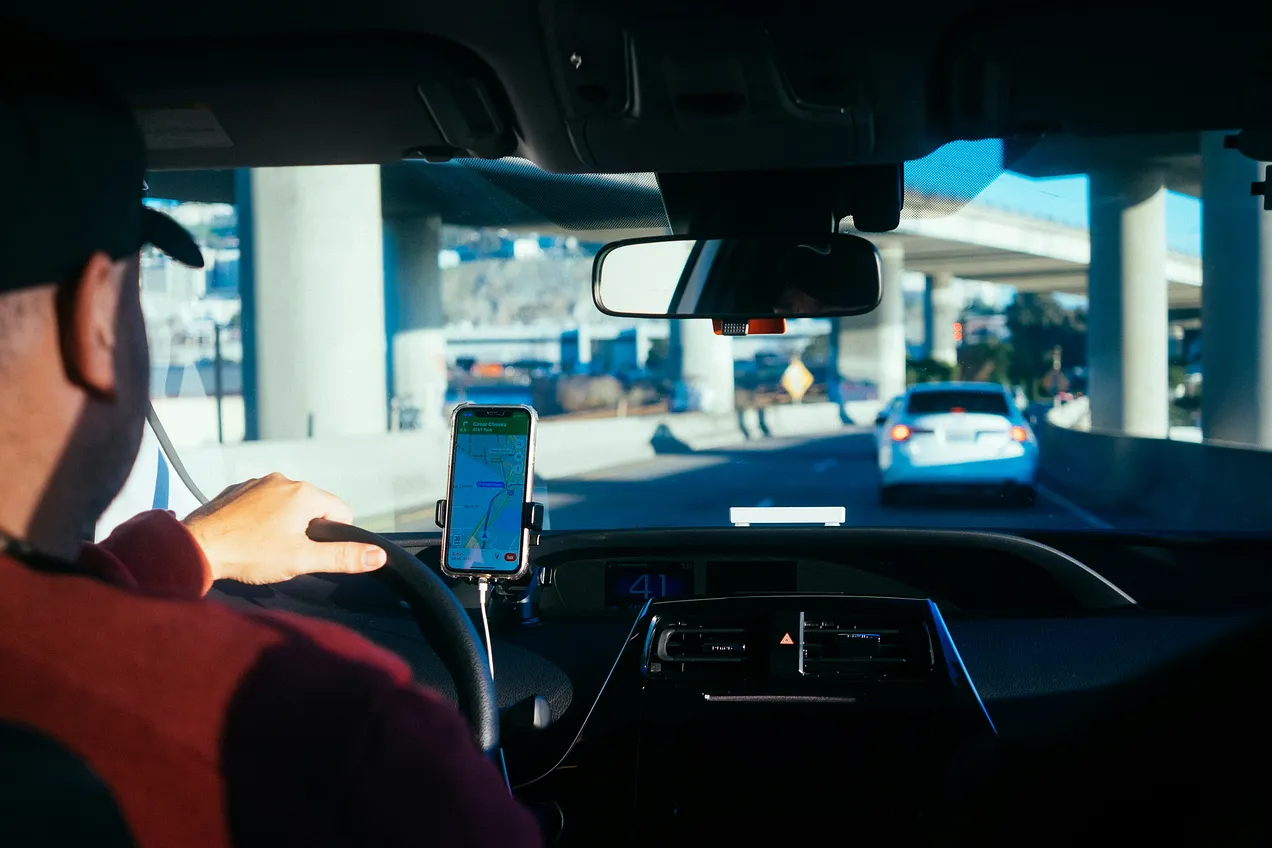
When Victoria Acosta started driving for Uber and Lyft in Massachusetts, the attraction was straightforward. She was raising three teenage sons on her own in Lynn, far from the family she had left behind in the Dominican Republic. Restaurant and factory jobs meant long hours away from her kids. Driving offered something those jobs did not: the ability to earn money and still be a mother.
For a while, the promise worked. Then the economics changed.
After more than five years behind the wheel, Acosta described working longer hours as pay became less predictable and expenses piled up. Like thousands of drivers, she owned the car, bought the gas, paid for maintenance and absorbed the risk. The app companies still controlled many of the rules. Acosta described that experience in detail in 2024.
Those worsening conditions eventually pushed Acosta into organizing with other drivers for a greater say over the rules governing their work.
A Gap in Labor Law
Drivers like Victoria had a problem that went beyond Uber or Lyft. They were caught in a gap in American labor law.
The National Labor Relations Act specifically excludes independent contractors. That meant rideshare drivers classified as contractors could not simply organize a conventional union under the federal system. Years of litigation over worker classification had done little to give drivers a reliable path to collective power.
The International Association of Machinists and Aerospace Workers (IAM) had seen a version of this problem before. IAM learned from organizing efforts with New York City “black car” drivers in the 1990s that even a decentralized, contractor-heavy driving industry could be organized and could support industry-wide benefits. Lessons from that experience eventually helped drivers and IAM establish the Independent Drivers Guild in 2016, a worker organization that could advocate for drivers even where traditional collective bargaining was unavailable.
But advocacy alone could not solve the underlying structural problem. Drivers needed a way to negotiate standards across an industry.
That pushed organizers to look elsewhere. The question was practical: could states use authority they already had to build worker power across an industry where federal labor law did not?
Countries with sectoral bargaining systems offered one model. In Sweden, for example, bargaining takes place predominantly at the industry level rather than company by company. OECD data show union membership above 60% and collective-bargaining coverage approaching 90%. The point was not to import Sweden’s system wholesale. It was to recognize that worker power can operate at industry scale, then ask what authority American states already have to build toward that.
The States Step In
In the United States, the most promising place to experiment is the states.
States already regulate wages, paid leave, safety and other basic conditions of work. They also have considerably more freedom to establish substantive labor standards than to create their own substitutes for the federal collective-bargaining system. That distinction has become central to what scholars call “sectoral co-regulation”: workers, employers and government participating together in setting standards for an industry. Cynthia Estlund recently explained the legal and practical logic of this approach in Labor Innovation.
Rideshare provided a chance to put some of those ideas into practice. After a yearslong campaign led by IAM and their partner, SEIU, Massachusetts developed a system in which drivers could demonstrate support for representation across the industry rather than organize Uber, Lyft and other companies separately. Voters approved Question 3 in 2024, creating a state-supervised process for industry-wide representation and bargaining.
Massachusetts was not alone. Illinois subsequently enacted its own rideshare labor-relations law. California has joined the movement. This month, its Public Employment Relations Board certified the California Gig Workers Union as the statewide bargaining representative for covered Uber and Lyft drivers. The details differ, but the direction is the same: states are building new ways for rideshare drivers to gain representation across an industry.
And Massachusetts is no longer an experiment on paper.
In May, the state certified the App Drivers Union, representing roughly 70,000 rideshare drivers. In August, the union began negotiations with Uber and Lyftover wages, benefits and working conditions.
Victoria Acosta helped make that happen. She knocked on doors, spoke with drivers and collected cards. When certification finally came, she said she had once thought sitting across the table from the companies was impossible. “For me, it is a dream come true,” she said.
Beyond the Gig Economy
The larger question is what rideshare can teach us beyond the gig economy, including in conventional W-2 sectors. Rideshare is not a perfect legal template for those.But with some important modifications, worker representation can be built at industry scale.
That suggests a third way in addition to conventional enterprise-by-enterprise unionization and ordinary government regulation. Consider an Industry Workforce Council: a state-created body bringing together employers, worker representatives and public officials to establish baseline standards for a sector.
Just like in the rideshare examples, worker representative organizations could qualify for meaningful participation by demonstrating credible support among a substantial share of the workforce, without first winning workplace after workplace. The council could then address pay, benefits, scheduling, safety and training across the industry.
There are practical reasons to think at that scale.
An industry-wide wage floor does not force one responsible employer to absorb higher labor costs while a competitor undercuts it. Industry-wide health or retirement benefits can spread administrative costs across employers, particularly benefiting smaller firms. Industry training programs can create credentials employers recognize and workers can carry with them. Co-enforcement can give workers and employers a role in identifying problems before every violation becomes a government investigation.
Those characteristics are particularly attractive in sectors where conventional organizing is most difficult: fast food, warehousing and logistics, hospitality, health care and other industries with high turnover, fragmented workplaces or layers of contracting.
None of this eliminates traditional unions or collective bargaining. Nor does it eliminate hard questions about representation, legal authority, accountability or how standards affect particular businesses. New institutions have to prove themselves.
The institutional advantage is straightforward: workers gain durable power in setting industry standards, employers participate in setting workable standards, and public officials retain responsibility for adopting and enforcing the rules. Because the standards apply across the sector, responsible businesses do not have to compete against firms built around lower labor standards.
States as Laboratories
Massachusetts has already demonstrated something important. A group of workers once largely outside the traditional labor-law system now has an organization representing them across an entire industry and is sitting across the table from the companies that determine the conditions of their work.
States have long been called laboratories of democracy. In labor policy, they are increasingly becoming laboratories in the more literal sense: places where Americans are testing institutions that federal law never contemplated.
Victoria Acosta did not need an academic debate about labor-law architecture. She needed a way for drivers to have a say over the rules governing their livelihoods.
The experiment now underway in Massachusetts asks whether we can build that kind of worker power at a scale the modern economy actually requires.
Andrew Greenblatt is Partnerships Director of the Center for State Labor Innovation and developed the original legal framework used in the rideshare legislation. As founder and executive director of the IDG Benefits Fund, he helped develop state-mandated benefits programs for app-based drivers.