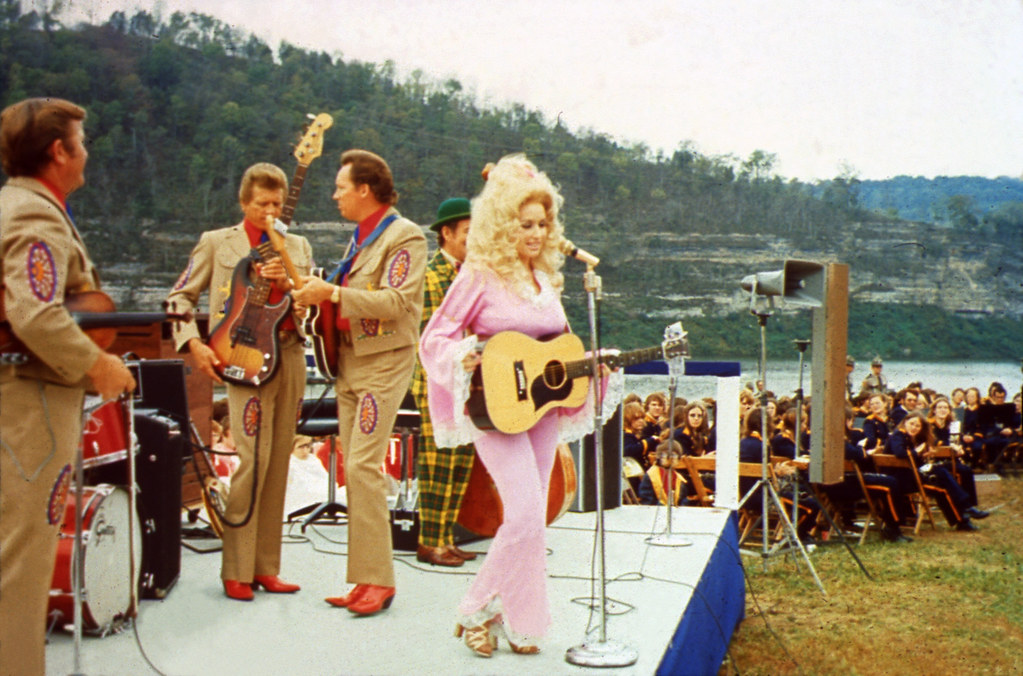
Dolly Parton understood working people.
Not in the abstract way politicians sometimes claim to understand them. She knew what it was like to grow up without much in rural East Tennessee, to watch people work hard without getting ahead, and to understand that talent and effort do not necessarily protect anyone from being overlooked.
Dolly, who died last Tuesday at 80, spent 70 years telling those stories. That was true in songs about poverty, heartbreak and scraping by. It was true in her work aiding families who needed books, tuition or simply enough money to get through a disaster. And nowhere was it more explicit than in “9 to 5,” one of the most recognizable songs about work ever recorded.
What is easy to forget is that "9 to 5" did not begin in Hollywood.
It began with workers organizing.
In 1973, a group of Boston clerical workers founded 9to5, a movement advocating for women clerical workers, in response to the low pay, discrimination, harassment and limited opportunities they encountered in office work. They organized across workplaces, confronted bosses and policymakers, developed worker leaders and helped build a national movement for working women.
The organization caught Jane Fonda’s attention. The screenplay that became 9 to 5 was based on conversations with 9to5 members around the country about their experiences at work. Fonda later remembered screening the finished movie for rooms full of secretaries. “They felt seen. They felt that they mattered,” she said.
Then Dolly Parton gave the movement a soundtrack.
The movie arrived in 1980 starring Dolly, Fonda and Lily Tomlin. It was a comedy about three women taking revenge on a spectacularly awful boss, but the joke worked because millions of women recognized the workplace underneath it. One secretary told The Washington Post when the film opened that, after a lifetime of movies about other professions, “finally ... secretaries would have their day.”
Dolly understood the significance herself. Asked years later about the song’s impact on working women, she said, “I think that it has really opened a lot of doors for women.”
Its cultural life lasted long after the credits rolled. Nearly four decades later, Sen. Elizabeth Warren was walking onto presidential campaign stages to “9 to 5.” Asked about the choice, Warren said the song captured “in many ways” what her campaign was about: “Women are here working 9 to 5.”
The organization behind the movie kept working, too. Over the decades, 9to5 helped fight for the Pregnancy Discrimination Act, Family and Medical Leave Act, improvements to the Civil Rights Act and the Lilly Ledbetter Fair Pay Act, while continuing to organize around wages, leave, child care and workplace protections at the state and local level. 9to5 describes those victories as part of a continuous effort to build power for working women beyond any single workplace.
The advocates at 9to5 gave women working for different employers a way to recognize that many of the indignities they faced were not individual problems at all. They were shared problems, and shared problems could be confronted together.
There is an interesting parallel in Dolly’s own profession.
She was a 58-year member of Nashville Musicians Association, AFM Local 257. After her death, the American Federation of Musicians remembered her as a “steadfast champion for working musicians”. Local 257 President Dave Pomeroy said Dolly and her team consistently filed union contracts for gigs, recording sessions and tours so that the musicians working alongside her received union benefits.
That matters in an industry where the workplace can change every night. Musicians may work for different artists, producers, studios and labels from one project to the next. The AFM has responded by negotiating agreements such as its Sound Recording Labor Agreement, which sets minimum wages and working conditions across covered recording work rather than leaving every musician to negotiate every job from scratch.
Dolly carried the same concern for dignity beyond the recording studio. Her Imagination Library grew out of the Dollywood Foundation’s work in her home county and became an international program putting free books into the hands of children regardless of family income. Before that, her Buddy Program promised local seventh- and eighth-graders $500 if they and a classmate both graduated from high school; the dropout rate for the participating classes fell from 35 percent to 6 percent.
When wildfires devastated Sevier County in 2016, her My People Fund did something refreshingly uncomplicated: it gave families money. The fund ultimately distributed more than $12 million directly to more than 900 families who had lost their homes.
The Recording Committee awarded Dolly the 2019 MusiCares Person of the Year, an honor tied to work that provides financial, medical and personal assistance to people who make their living in music.
Her commitment to education also earned recognition from organized labor. In 2022, the National Education Association gave Dolly its Friend of Education Award, the union’s highest honor. NEA’s then-President Becky Pringle called her a “national treasure” and praised her for championing literacy and learning while responding to disasters and other community needs.
In 2022, the Carnegie Medal of Philanthropy recognized her work alleviating poverty, expanding educational opportunity and supporting communities in need, citing the ways her philanthropy had “empowered and lifted up” people in Tennessee and around the world.
None of this makes Dolly Parton a labor-policy theorist. Trying to turn her into one would flatten what made her remarkable.
She was something more endearing: an artist who could make the frustrations and aspirations of working people impossible to miss, and who repeatedly used her own success to make life a little easier for someone else.
Sometimes that meant a song.
Sometimes it meant a union contract.
Sometimes it meant a free book arriving in a child’s mailbox or a check arriving after a family had lost everything.
And sometimes it meant three women on a movie screen realizing that the problem they thought they faced alone was shared by the woman at the next desk.
Dolly Parton understood the power in that long before most of America learned to sing along.