
I wholeheartedly support the CSLI vision of the need for significant innovation in worker organizing and the need to focus on state-level initiatives given the hopeless situation in the federal government.
In this brief note, let me suggest ways to build on this vision and strategy to address the most important challenge and opportunity facing workers, unions, and employers: How to bring workers’ voices into the development and use of AI. I’ve been focusing on this issue for the past few years and my forthcoming bookargues that addressing AI in new ways is essential for building a new social contract at work.
To date, most efforts to gain a voice for workers have occurred through collective bargaining in the private sector and/or agreements between unions and selected AI developers. Actions at the state level to date focus on getting legislatures to enact various guardrails governing use of AI. Yet, there may be potential for states to go further by bringing worker representatives and employer groups together to discuss and negotiate options for building worker voice into select occupational or sectoral settings.
What Workers Want
American workers are telling us they want a greater voice on AI. In current work in progress analyzing the 2025 American Job Quality Study (AJQS), Alex Hertel-Fernandez and I found that three-fourths (76%) of the workforce believe they should have “some” or “a lot” of say on the use of AI and other new technologies while only 43% report having this amount of influence.
This “voice gap” has consequences: A higher voice gap is associated with lower job satisfaction, more concerns about health and safety at work, and more stress and anxiety. And, we show that the size of these voice gaps are strong predictors of workers’ interest in joining a union. So, the challenge for unions and other worker organizations is how to reach those who want a stronger voice on AI and then how to meet their expectations.
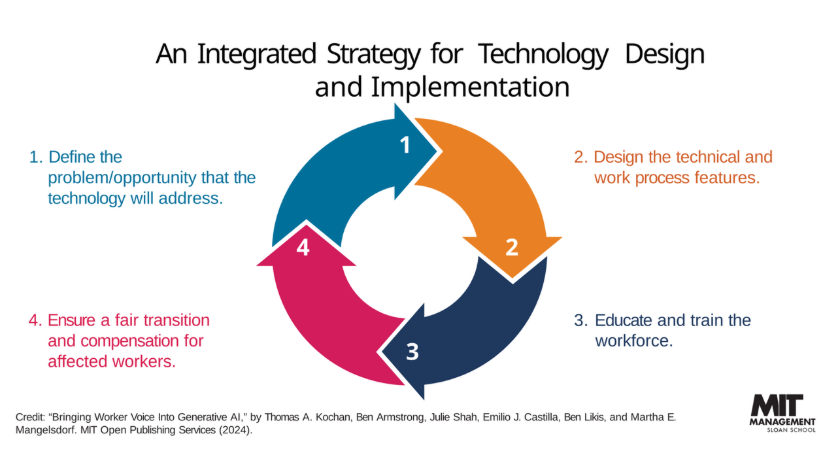
In my work on this issue, I emphasize the need for workers to gain a voice in all phases of AI decision-making shown in Figure 1 including (1) the choice of the problems or opportunities AI is expected to address are defined, (2) how AI tools are designed and linked to specific jobs, (3) the training workers need to use AI effectively, and (4) how the benefits of AI are shared with the workforce and the adjustment assistance is provided those who may be displaced. Other AI researchers who study work now generally agree that unless workers have a voice in these key decisions, AI developers will focus on building tools that outsmart humans and replace workers. And if information technology specialists and other managers design the specific features of AI tools without worker input, they too will often “overautomate” and result in the need for redesign of these tools.
Promising Developments
A growing number of unions are addressing AI in collective bargaining and in ongoing engagement with some employers and some AI developers. For example, the AFL-CIO, the United Federation of Teachers, the Communications Workers of America, the National Education Association, and the North American Building Trades have each reached agreements to work with one or more big development firms such as OpenAI, Microsoft, and/or Anthropic. UNITE-HERE has successfully used collective bargaining with casinos, hotels and entertainment sites to gain a voice in all phases of technological change with advance notice of AI plans, the right to consult on these plans, training for workers involved, and access to new jobs for workers who are displaced. In 2025, the Alliance of Health Care Unions and Kaiser Permanente negotiated what we believe to be a breakthrough, innovative, agreement that includes a “bottom-up” opportunity for teams of workers to identify ways to use AI to improve their work processes and patient care and a “top-down” labor-management oversight task force to discuss AI projects in their early stages of development and implementation. The agreement also calls for training workers and work teams on AI and prior bargaining agreements provide for worker adjustment protections.
More unions need to make AI a priority issue in collective bargaining. But to gain a voice in all four phases of AI development and use requires enough bargaining power and a commitment to engaging employers on an ongoing basis on issues that typically lie outside the “mandatory” scope of bargaining. I expect these efforts to grow, but this will be a necessary not a sufficient strategy for bringing unionized workers’ voices into AI and will not reach the vast majority of nonunion workers. So, the question on my mind is whether state level initiatives might be a path worth pursuing.
Current State Level Initiatives
State level labor groups, along with the AFL-CIO Technology Institute and a cross-state AI Task Force, have been very active in proposing and in many cases achieving “guardrails” that regulate specific employment practices dealing with issues such as discrimination, worker data privacy, and human review of AI generated recommendations. New York and Connecticut have updated their laws requiring advance notice of mass layoffs to cover layoffs due to AI and a host of other states have bills pending on this issue. A Wisconsin Governor’s Task Force on Workforce and Artificial Intelligence has used federal money to fund training grants to sectors affected by AI. To date, however, none of these state level initiatives provide any new rights or opportunities for worker voice in AI development or use.
Could State Level Unions and/or Professional Groups Start Demanding a Voice in AI?
The initiatives mentioned above by the American Federation of Teachers and the National Education Association to work with AI development firms are sectoral, or in this case occupation-wide, consultation that could serve as models for other professional associations to do the same, particularly those representing middle management and lower level professional occupations that the Brookings Institution has shown are most exposed to AI.
If this is done well, I predict AI developers and vendors will compete with each other for opportunities to work with these professionals to build AI tools that support their work while making them more productive employees. There is money on the table for developers, employers, and the workforce to share.
But the big question is how some form of bargaining on AI could be structured on an occupational or sectoral basis. Here we might take a page out of the sectoral bargaining systems established in Massachusetts, California, and Illinois for ride service workers. These models pass legal muster because the state government oversees and has the authority to approve negotiated or arbitrated agreements. One critical feature of these models is that significant union organizing must be achieved before the process is certified. If this process works well in these initial states, I predict they will quickly spread to others, perhaps akin to the way public sector bargaining rights spread across the country in the 1960s after some initial successes in Wisconsin and a few other states.
Could a version of the ride service model be used to organize other occupational groups in which state governments have an interest, not the least of which is the growing worries that agentic AI tools are getting out of control? Why not give this a try. Coalitions of state labor organizations and professional occupation associations could make a strong case that their state needs to ensure that AI is developed and used for the common good and that worker voice is a pathway for doing so.
State-based initiatives like this or others yet to be invented may be a promising path to give workers the voice they are demanding and they need in all phases of AI development and use.
Thomas A. Kochan is a Professor Emeritus at the MIT Sloan School of Management and the Institute for Work and Employment Research. This note draws on his forthcoming book: “Roads not Taken: Lessons for Building a New Social Contract at Work.” Forthcoming, MIT Press, January 2027.