
For millions of workers, the basic rules of work are set far from the people who live under them. In sectors built around franchises, subcontractors, app platforms, domestic households, staffing agencies, and small worksites, wages and working conditions are often shaped across an industry, while workers have few practical ways to help set the standards that govern their jobs.
One answer, long present in American labor policy and now getting renewed attention in the states, is to bring workers, employers, and the public together to set minimum standards for particular industries. Consider California’s 2022 FAST Act, which created a tripartite Fast Food Council with representatives of workers and worker organizations, employers (both franchisors and franchisees), and the public to set minimum wage levels and labor standards in that sector. Standards approved by a Council majority, after public notice-and-comment and absent legislative disapproval, would become binding on all California fast food employers.
Although a revised law diluted some of its innovative features, the FAST Act exemplifies a hybrid form of labor lawmaking—call it “sectoral co-regulation”—that can supplement, not supplant, existing strategies for improving wages and working conditions at lower levels of the labor market. It promised to give a greater voice to workers and to improve working conditions in a low-wage industry with stubborn barriers to unionization.
The two basic pillars of US labor policy since the New Deal have been enterprise-based collective bargaining, grounded in the National Labor Relations Act (NLRA), and jurisdiction-wide minimum labor standards, starting with the Fair Labor Standards Act (FLSA). Those pathbreaking statutes established complementary strategies for raising labor standards: The NLRA enabled workers to form unions and bargain for themselves, backed by collective self-help. The FLSA set a more-or-less universal national floor on some basic labor standards (and left states as well as future Congresses free to raise and extend that floor), both to protect workers who could not bargain collectively and to raise the floor for bargaining by those who could. This two-pillar strategy helped spread prosperity across the US economy for several decades.
But private sector collective bargaining through unionization has sunk to historically low levels and has fallen out of reach for most workers. That is a major reason why workers without higher education or advanced skills have captured a shrinking share of national income.
These trends have drawn many US labor scholars and advocates toward the idea of sectoral bargaining, in which collective bargains are struck at the sectoral level between unions and employer associations and extended across the sector, partially insulating them from cost-based competition. Sectoral bargaining in Europe partly explains both higher union density and the smaller rise in economic inequality in recent decades. But to get sectoral bargaining off the ground in the US would require both higher union density and, given the preemptive force of federal labor law, action from Congress, where labor law reform has gone to die over the past half-century.
Sectoral regulation, on the other hand, has been around for at least 150 years, and is currently having a moment, mainly at the state level. Regulatory strategies rely on democratic politics and governmental power, not workers’ bargaining power, to improve labor standards. Conventionally, regulatory processes for standard-setting include no formal role for workers or their organizations. But California’s Fast Food law adopts a co-regulatory standard-setting process, i.e., one that meaningfully engages affected workers and their organizations alongside representatives of employers and the public.
Sectoral co-regulation offers an alternative strategy, alongside enterprise-based bargaining and across-the-board minimum standards, for raising labor standards at lower levels of the labor market. It fills part of the vacuum left by union decline by giving workers a voice in devising and enforcing higher-than-minimum sectoral standards.
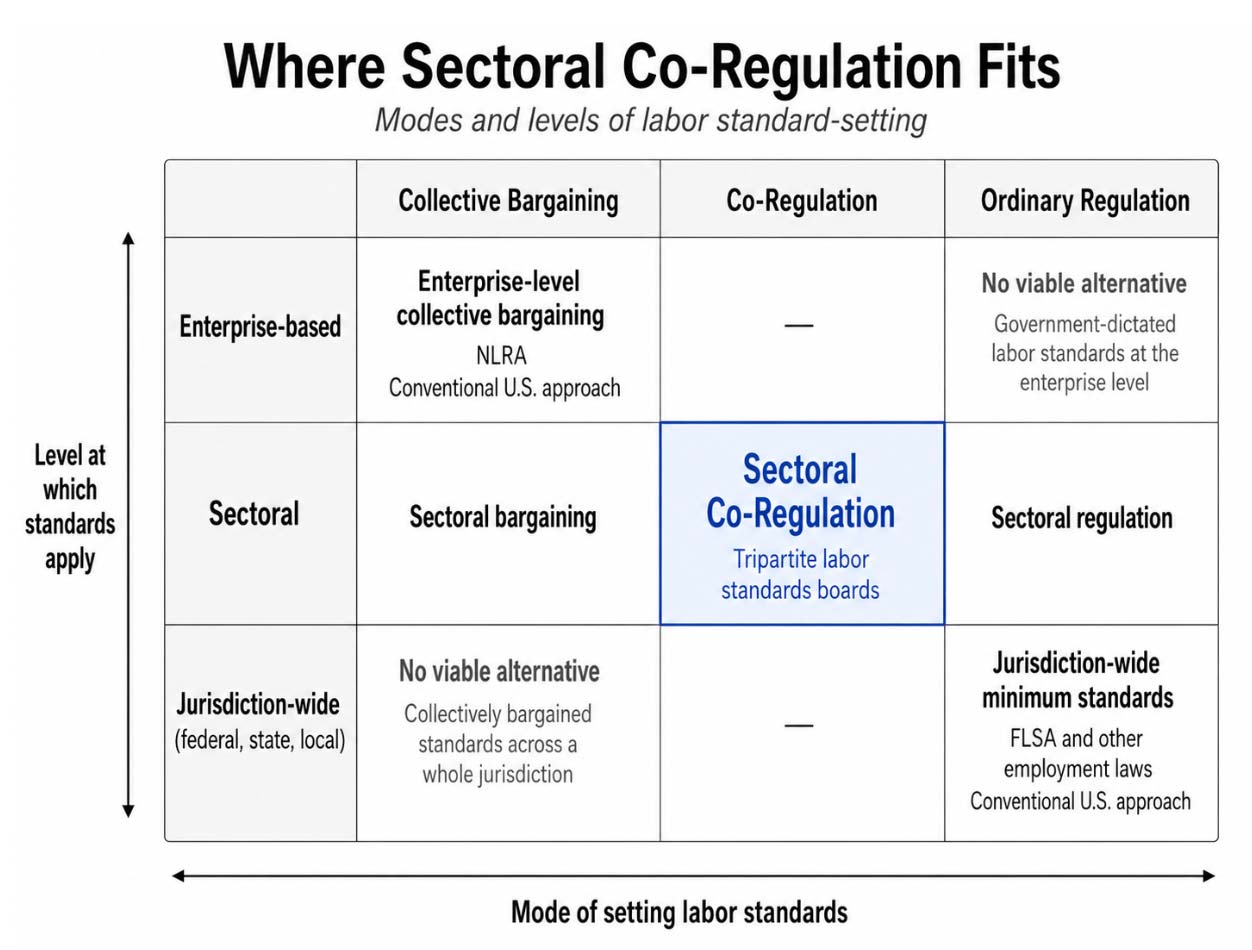
To appreciate the virtues of sectoral co-regulation, it helps to step back from the familiar categories of US labor law. For most of the New Deal era and after, we have relied largely on two main strategies: enterprise-based collective bargaining and jurisdiction-wide minimum labor standards. Those strategies remain essential. But as the table above (Figure 1) shows, they occupy only part of the available terrain.
Neither government-dictated labor standards at the enterprise level (upper-right) nor collectively bargained standards across a whole jurisdiction (lower-left) are realistic. But the middle ground is much more interesting. Sectoral standards can be set above the enterprise level without becoming one-size-fits-all rules for an entire jurisdiction. Co-regulatory strategies can use public authority while still engaging the workers, employers, and other stakeholders most directly affected by the standards being set.
The California labor standards board, like its cousins in New York and elsewhere, sits at the midpoint of both dimensions: It sets binding public standards at the sectoral level, with participation from representatives of workers and employers alongside public officials. That combination is the key. Sectoral standards have advantages over both enterprise-based and jurisdiction-wide standards; and co-regulation has advantages over both collective bargaining and conventional regulation. Yet sectoral co-regulation is also compatible with both jurisdiction-wide minimum standards and enterprise-based collective bargaining. It can supplement those approaches without displacing them.
Sectoral Standards Versus Enterprise-Wide or Jurisdiction-Wide Standards
Sectoral labor standards, whether set by collective bargaining or otherwise, can address the Achilles’ heel of enterprise-based standards by constraining labor-cost-based competition within the sector and forcing firms to compete instead through higher productivity, quality, and innovation. Sectoral labor standards can also surmount the “least-common-denominator" problem with jurisdiction-wide standards. They can be higher than what is feasible across a whole jurisdiction and can address sector-specific conditions.
To be sure, sectoral standards still face competition from outside the jurisdiction within which they prevail. They must take into account labor and product market forces within the sector. But sectoral standards, unlike jurisdiction-wide standards, can take into account sector-specific factors like the scope of the relevant product market (whether local, regional, national, or transnational). Sectoral standard-setting can be opportunistic in a positive sense. Higher sectoral wage floors at a state (or local) level might be sustainable, for example, in relatively concentrated sectors (like hospitals in many regions, or Amazon warehouses), or in localized product markets (like hospitality and fast food).
Co-Regulation Versus Bargaining
Tripartite wage boards raise labor standards through the exercise of state regulatory power, not based on workers’ collective bargaining leverage—their ability to put economic pressure on employers through strikes or the like. Our labor laws promised to enable workers to secure better wages and working conditions by organizing and aggregating their bargaining power. But very few workers today have access to that framework, given the severe challenges of union organizing and of gaining a collective agreement. Moreover, even if labor law were reformed to better enable workers to aggregate their bargaining power, most workers just don’t have enough of it.
Globalization, deregulation, fissuring, and technological innovations have all tended to sap workers’ bargaining power relative to capital, in part by expanding employers’ ability to replace employees with other workers or technological substitutes. Labor law reform would do little to address those deeper sources of workers’ declining labor market power. Workers need to supplement their labor market power, not only to aggregate it. That militates for greater reliance on regulatory strategies for improving work and wages at lower levels of the labor market.
An additional advantage of regulatory strategies for raising labor standards lies in the arcane doctrine of federal labor preemption. Labor obviously has greater political clout, and is better able to form supportive political coalitions, in several states than at the national level. Yet federal labor law preempts state (and local) regulation of private sector collective labor relations processes, including any hypothetical state scheme of sectoral collective bargaining. By contrast, federal law does not preempt the enactment of higher substantive labor standards at the state level. (Stay tuned for more on this in a later post.) There is much more room for state regulation of substantive labor standards than for state regulation of collective bargaining processes.
Co-Regulation Versus Conventional Regulation
Co-regulation aims to democratize standard setting by directly engaging workers and their organizations in the standard-setting process, and tapping into workers’ invaluable on-the-ground knowledge of conditions and their interest in improving and enforcing labor standards.
Both of the conventional strategies for setting labor standards have their own democratic bona fides: Collective bargaining democratizes labor standard-setting by giving workers, sitting across the table from employers, direct input and a joint voice in setting standards within their own enterprise. Legislated minimum labor standards reflect democratic political processes through which the public at large defines decent standards of work. Co-regulation borrows a page from each of those conceptions of democracy: It expresses the public’s will, through democratic political channels, to democratize the process of setting public labor standards by engaging those most directly affected.
* * *
Questions about sectoral co-regulation abound, including how these structures can be made both more democratic and more sustainable, and how they should fare against legal challenges based on federal preemption doctrine. But sectoral co-regulation is an idea whose time has returned. Workers need more leverage than they have within our flawed and faltering system of enterprise-based collective bargaining, and they need more of a voice than they currently have in formulating or enforcing legislated labor standards. Sectoral co-regulatory institutions, like the tripartite labor standards boards in states across the country, combine some of the virtues and combat the respective shortcomings of both collective bargaining and conventional regulatory strategies for improving terms and conditions of work. They deserve a serious place in the labor law toolkit.
Cynthia Estlund is the Crystal Eastman Professor at the New York University School of Law, and is the author of four books and over 80 articles and essays on various aspects of the law of work in the US and beyond.
P.S. Interested in writing about building worker power? We’d love to hear your idea for Labor Innovation. Contact us here.